
Religious Trauma Recovery Support Group
An 8-week, trauma-informed support group for healing from religious harm, spiritual abuse, and shame-based systems
This 8-week support group offers a steady, compassionate space for adults healing from religious trauma, spiritual abuse, coercive control, and fear- or shame-based belief systems.
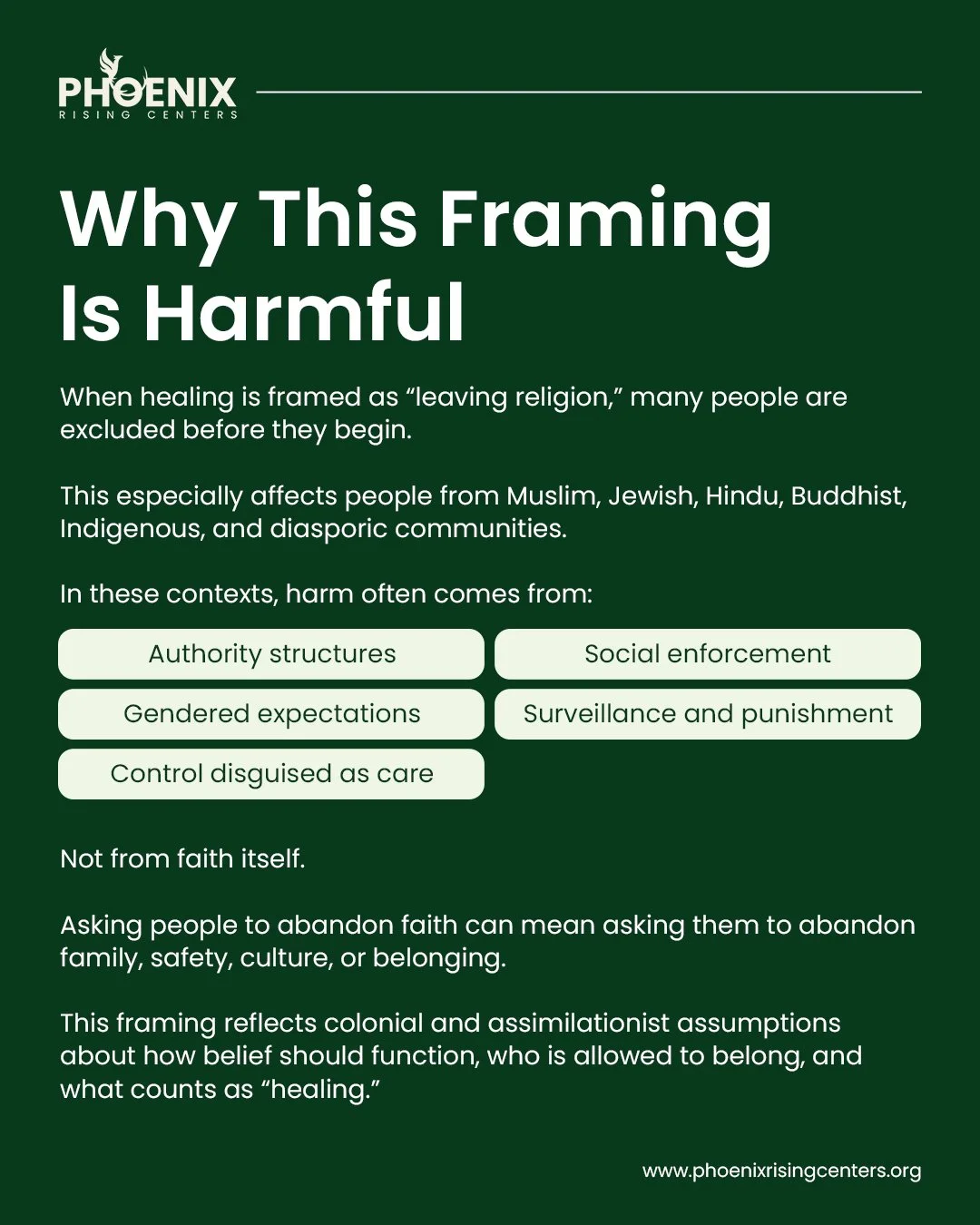
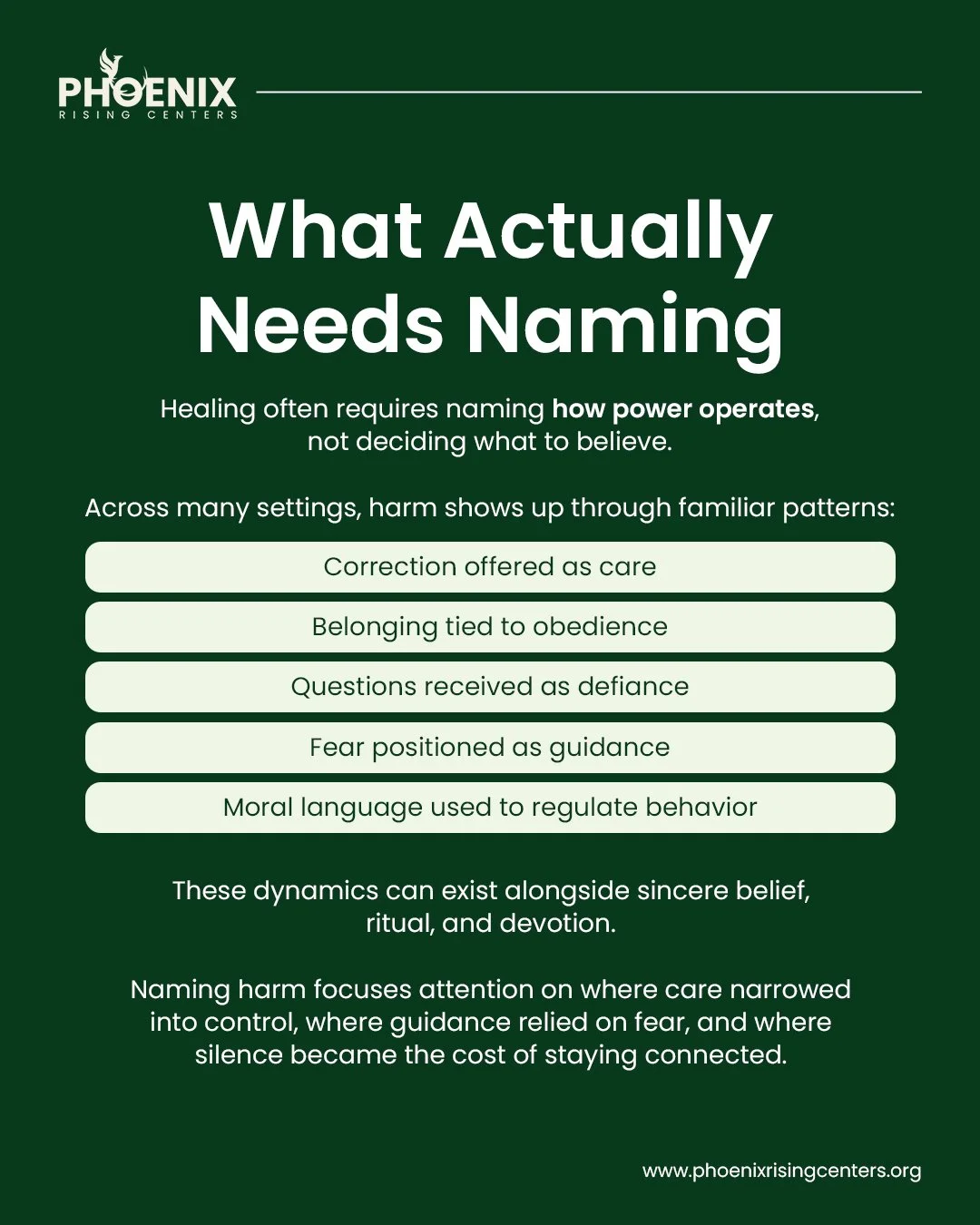
Rather than treating religious trauma as a personal failure or lack of faith, this group understands it as a response to systems of power, control, and conditioning that shape the nervous system, identity, relationships, and sense of safety.
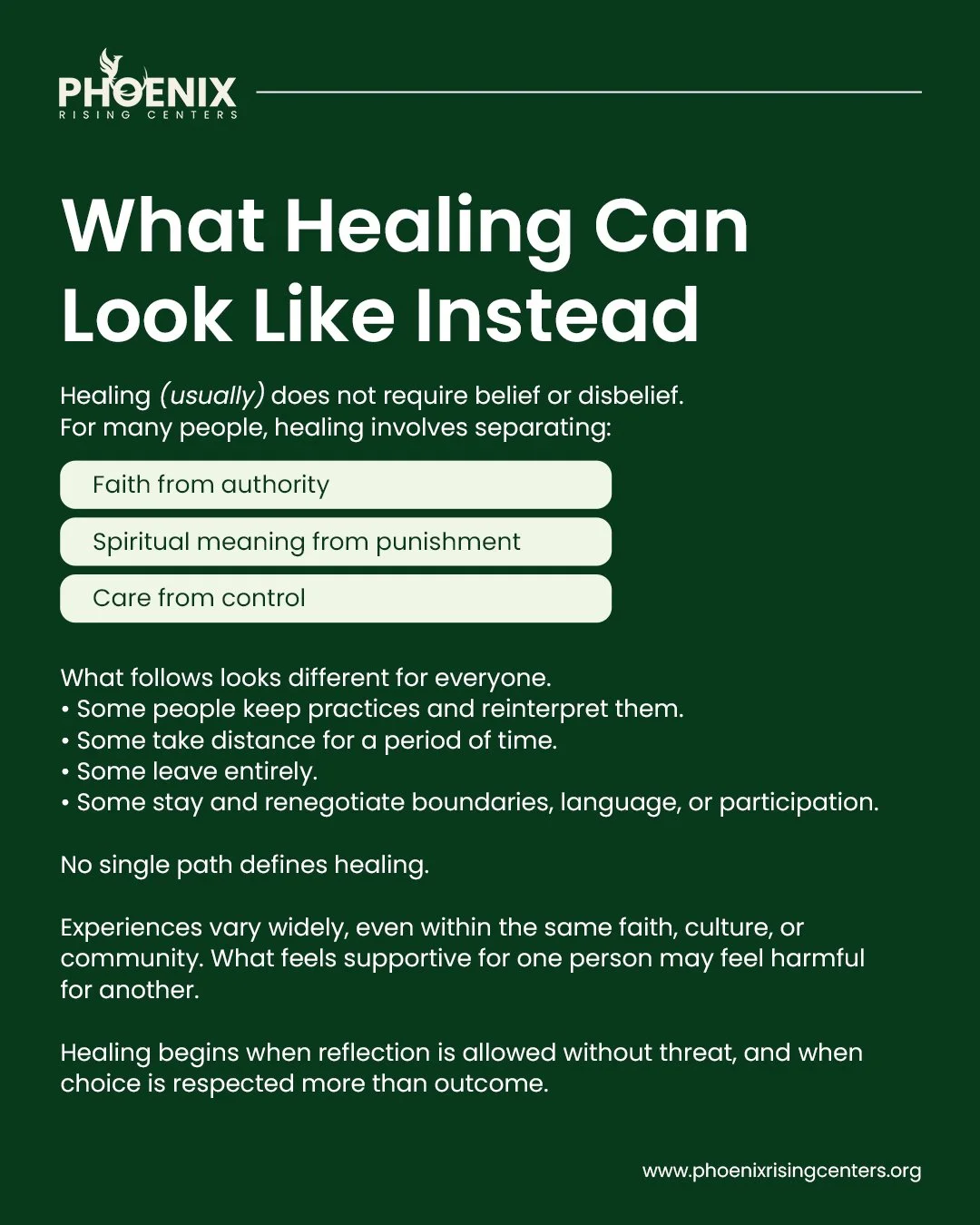
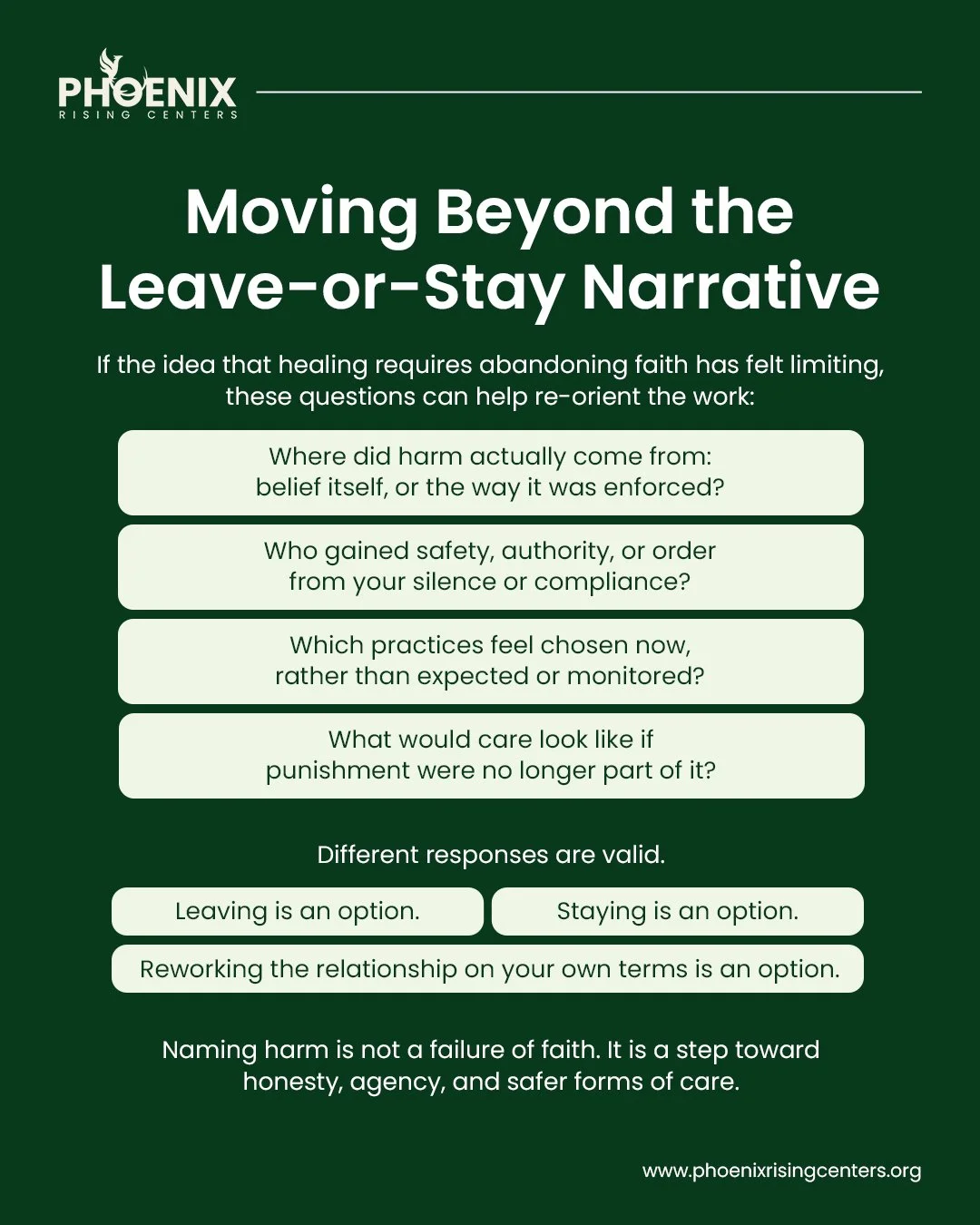
Participants are supported in building autonomy, grounding, self-trust, and meaning-making — at their own pace, and without pressure to believe, disbelieve, or arrive at any specific conclusion.
You do not need to be religious to participate. This group welcomes people who are still practicing, questioning, deconstructing, or fully secular.
-
Adults (21+)
This group welcomes adults of all identities and backgrounds, including queer, transgender, neurodivergent, immigrant, Black, Indigenous, Asian, white, and multiracial participants, as well as anyone impacted by religious trauma or spiritual harm.
-
This group uses a community sliding scale so that care can remain accessible while also fairly compensating the therapists who prepare for and hold this space.
Please choose the rate that reflects your current financial capacity:
$ — Reduced Rate
$30 per session ($240 total)
$$ — Sustaining Rate
$60 per session ($480 total)
$$$ — Community Support Rate
$80 per session ($640 total)
This tier helps sustain the group and supports lower-cost spots for others.
Payment is collected upfront for all 8 weeks so we can secure therapist time, preparation, and group capacity in advance.
If paying upfront would be difficult for you, please email us. We’re open to working something out when possible.
You will not be asked to prove your tier. We trust you to choose honestly and with care for the community.
Choosing a higher tier directly supports access for someone else while sustaining the clinicians who hold this space.
-
A trauma-informed support group focused on understanding and healing from religious or spiritual harm.
This group integrates:
Psychoeducation
Somatic grounding and nervous system regulation
Cognitive reflection and reframing
Narrative and meaning-making practices
This is a support group, not a replacement for individual trauma therapy. It is designed to complement personal care and honour each participant’s capacity, consent, and pace.
-
8 weeks
90 minute sessions (virtual)
Small, trauma-informed support group
Consent-based and paced environment
Participants choose one consistent weekly time slot.
-
If you’re unsure whether this group feels right for you, or you simply have questions, you’re welcome to reach out.
We offer a free 15-minute consultation so you can ask questions, share concerns, and get a sense of whether this space feels supportive for you.
There’s no pressure to join.
Email us at support@phoenixrisingcenters.org
-
Program begins March 20th 2026.
Available weekly options:
Sundays: 10:00 AM – 11:00 AM
Mondays: 7:00 PM – 8:00 PM
Thursdays: 6:30 PM – 7:30 PM
Affirm religious trauma as a legitimate form of trauma
Understand how faith-based systems shape identity, coping, and self-perception
Reduce shame, fear, and internalised self-blame shaped by doctrine
Rebuild autonomy, consent, and self-trust
Process grief related to loss of community, belief, or belonging
Support identity reconstruction and values clarification
Foster connection in a respectful, non-pressured group space
GROUP GOALS
WEEKLY OVERVIEW
Week 1:
Orientation, Safety & Group Agreements
Introductions and shared intentions
Defining religious trauma and spiritual abuse
Consent-based group agreements
Grounding and orienting to safety in the body
Week 2:
Understanding Religious Trauma
Power, fear conditioning, purity culture, authoritarian structures
Trauma responses (fight, flight, freeze, fawn)
How belief systems shape behaviour and identity
Week 3:
Shame, Guilt & Internalised Beliefs
Differentiating shame and guilt
Identifying doctrine-based self-criticism
Beginning cognitive reframing and self-compassion
Week 4:
Body Autonomy, Consent & Somatic Healing
How religious trauma lives in the body
Reconnecting with bodily autonomy
Consent as a healing practice
Week 5:
Grief, Loss & Estrangement
Loss of community, family, rituals, or identity
Navigating ambiguous loss
Making space for non-linear grief
Week 6:
Triggers, Rituals & Reclaiming Meaning
Identifying triggers (holidays, music, scripture, spaces)
Boundary-setting and exposure pacing
Creating personal grounding or meaning-making rituals
Week 7:
Identity Reconstruction & Values Clarification
Exploring identity beyond doctrine
Clarifying personal values and agency
Making space for spiritual, secular, or hybrid meaning
Week 8:
Closure, Integration & Future Support
Reflecting on growth and resilience
Integrating tools and insights
Sharing resources and next steps
Closing ritual

THIS GROUP MAY BE A GOOD FIT IF YOU:
Are healing from religious trauma or spiritual abuse
Carry shame, fear, or guilt linked to faith-based teachings
Have experienced loss of community or belonging
Want a trauma-informed, consent-based group spaceAre seeking support alongside or outside individual therapy
THIS GROUP MAY NOT BE THE RIGHT FIT IF:
You are seeking this group as a replacement for individual trauma therapy
You are currently experiencing active suicidal ideation requiring a higher level of care
You are seeking theological debate, conversion, or belief validation
You are engaging in self-harm that requires immediate medical intervention
If you’re unsure about fit, or feel hesitant about joining a group space, you’re welcome to reach out or book a free 15-minute consultation to talk it through. Just drop us an email us at: support@phoenixrisingcenters.org
GROUP FACILITATOR

Specializes in Jungian Therapy, Spirituality, LGBTQIA+ Care, Substance Use & Emotional Healing
Austin Davis, PLCSW (He/Him)
Provisionally Licensed Clinical Social Worker • Rhode Island
Austin provides compassionate, affirming therapy for people exploring identity, spirituality, belonging, and emotional well-being. Drawing from Jungian, psychodynamic, and social justice-informed approaches, he supports clients navigating LGBTQIA+ experiences, substance use, life transitions, and the deeper questions that shape meaning and purpose.
INTERESTED
IN JOINING?
Space is intentionally limited to support safety and connection.